Planning Mexican catering for guests with different dietary needs requires more than ordering a few trays and hoping everyone finds something they can eat. A successful menu should account for allergies, gluten restrictions, vegetarian preferences, dairy concerns, spice tolerance, and other individual requirements before the event begins.
The best approach is simple: collect dietary information early, build the menu around flexible components, clearly label dishes, and never assume that an item is safe for someone with a medical food restriction without confirming ingredients and cross-contact procedures with the caterer.
For Las Vegas parties, office lunches, family gatherings, and corporate events, a customizable Mexican menu can provide variety while keeping service practical.
Quick Dietary Catering Planning Guide
| Dietary Need | Planning Approach | Questions to Ask |
| Vegetarian | Include a substantial meat-free entree | Are beans, rice, sauces, and tortillas prepared without animal products? |
| Vegan | Remove meat, dairy, and other animal-derived ingredients | Does any recipe contain cheese, crema, lard, or other animal ingredients? |
| Gluten-Free | Identify ingredients and cross-contact risks | Are tortillas, marinades, sauces, and prep surfaces verified? |
| Dairy-Free | Keep cheese and creamy toppings separate | Do sauces, marinades, or sides contain milk ingredients? |
| Food Allergies | Speak directly with the caterer | What ingredients and cross-contact risks are present? |
| Mild-Spice Preference | Serve hot sauces separately | Which foods are seasoned spicy before serving? |
Quick answer: The safest way to plan catering for mixed dietary needs is to create a flexible menu with clearly separated proteins, tortillas, sides, toppings, and sauces. Collect restrictions before ordering and discuss medically necessary accommodations directly with your caterer rather than making assumptions based only on menu names.
Start by Asking Guests About Dietary Needs Early
Do not wait until food is being served to discover that several guests cannot eat the available options.
When collecting RSVPs, include a simple question such as:
“Do you have any dietary restrictions or food allergies we should know about?”
Ask guests to be specific. There is an important difference between a personal food preference, a vegetarian or vegan diet, a food intolerance, celiac disease, and a diagnosed food allergy.
These situations may require different levels of preparation.
The nine major food allergens recognized in the United States are milk, eggs, fish, crustacean shellfish, tree nuts, peanuts, wheat, soy, and sesame. Food-allergy reactions can potentially be serious, which is why ingredient verification should never be left to guesswork.
For severe allergies or medically necessary restrictions, communicate the exact requirement directly to the catering provider before placing the order.
Build Your Mexican Catering Menu Around Flexible Components
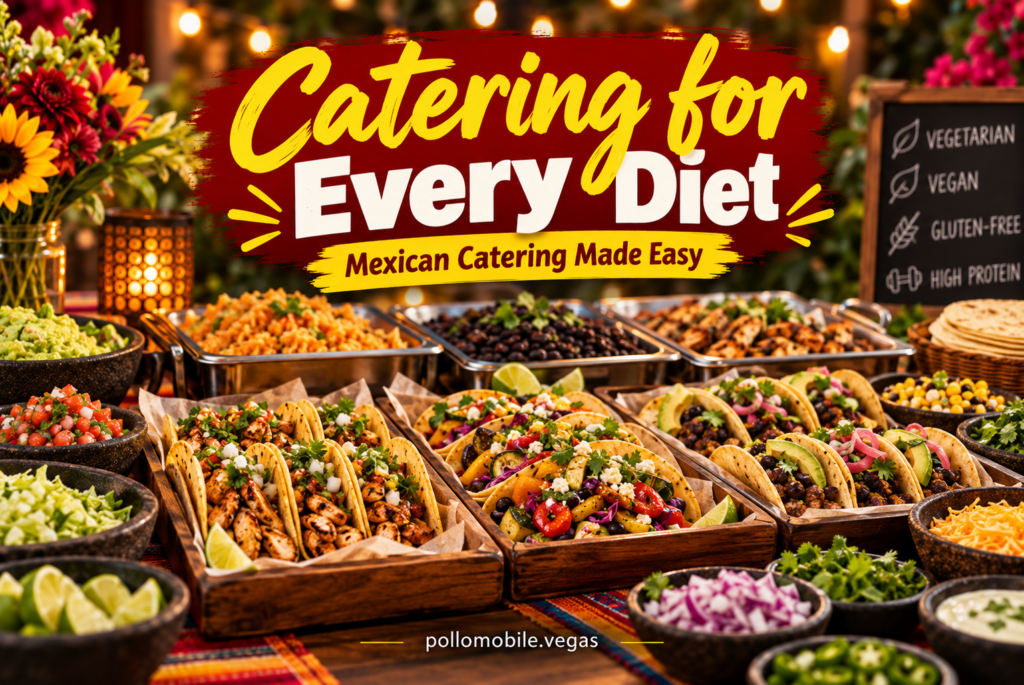
One advantage of Mexican catering is that many meals can be assembled from separate components.
Instead of serving one fully assembled dish to everyone, consider a menu built around:
- Proteins
- Tortillas
- Rice
- Beans
- Salsa
- Onions
- Cilantro
- Guacamole
- Cheese
- Additional toppings
This allows guests to create a meal that better matches their preferences.
Pollo Mobile offers Mexican catering in Las Vegas centered around items such as its signature charbroiled chicken and Mexican-style menu selections for parties, family gatherings, and corporate events.
How to Plan Catering for Vegetarian Guests
A common mistake is assuming that removing meat from a plate automatically creates a satisfying vegetarian catering option.
Your vegetarian guests should have an actual meal, not simply tortillas and salsa while everyone else receives a complete entree.
Consider planning:
- A substantial meat-free main option
- Rice and beans, after confirming ingredients
- Vegetable-based taco fillings
- Guacamole
- Salsa
- Tortillas
- Meat-free toppings
The most important step is verifying how dishes are prepared. A menu item may appear vegetarian while containing an animal-derived ingredient in the cooking process.
Expert tip: Estimate vegetarian meals based on your confirmed guest count, then add a small buffer. Guests who normally eat meat may also choose vegetarian options, especially when they look appealing.
How to Plan Mexican Catering for Vegan Guests
Vegan catering requires more attention than simply excluding meat.
Depending on the recipe, you may also need to avoid:
- Cheese
- Crema
- Butter
- Milk-based sauces
- Certain animal-derived cooking ingredients
Keep toppings separate whenever possible. This gives vegan guests more control and prevents cheese or dairy-based sauces from automatically being added to their food.
A practical vegan station might include verified plant-based fillings, tortillas, vegetables, salsa, onions, cilantro, and guacamole.
Again, confirm every relevant ingredient with the caterer before describing an item to guests as vegan.
How to Handle Gluten-Free Catering Requests
Mexican-style menus may offer dishes made with ingredients that do not naturally contain gluten, but that does not automatically make a catered meal safe for someone with celiac disease.
When planning gluten-free Mexican catering, ask about:
- Whether tortillas contain wheat
- Marinades and seasoning blends
- Sauces
- Shared cooking surfaces
- Shared utensils
- Shared fryers
- Serving equipment
Preference vs. medical requirement
A guest avoiding gluten by preference may make different choices from someone with diagnosed celiac disease.
For medically necessary gluten avoidance, the guest and caterer should communicate directly whenever possible.
Do not promise that a food is gluten-free simply because one obvious ingredient, such as a flour tortilla, has been removed.
How to Accommodate Dairy-Free Guests
Mexican food can be easy to customize visually, but dairy sometimes appears in less obvious places.
Common items to verify include:
- Cheese
- Crema
- Sauces
- Dressings
- Desserts
- Certain prepared sides
One of the easiest solutions is to serve cheese and dairy-based toppings separately.
For example, rather than preassembling every taco with cheese, create a serving setup that lets guests choose their own toppings.
Take Food Allergies More Seriously Than Food Preferences
A guest saying, “I don’t like cheese,” is very different from a guest saying, “I have a severe milk allergy.”
For serious food allergies, the main issue may not be only the ingredient list. Allergen cross-contact can occur when an allergen is unintentionally transferred between foods during preparation or handling.
When a guest reports a serious allergy:
- Identify the exact allergen.
- Tell the caterer before ordering.
- Ask about ingredients and preparation.
- Ask about shared equipment and surfaces.
- Clearly label the affected meal.
- Avoid making safety guarantees the caterer has not confirmed.
For high-risk dietary requirements, separately prepared and packaged meals may sometimes be more practical than trying to adapt a shared buffet.
Don’t Forget Different Spice Tolerances
Not every dietary need is an allergy.
At a large Las Vegas event, your guest list may include children, older adults, serious chile lovers, and guests who prefer mild food.
The easiest solution is to keep the main menu broadly approachable and offer additional heat through separate salsas and sauces.
Label options clearly:
- Mild
- Medium
- Hot
This allows spice lovers to customize their plates without making the entire menu uncomfortable for everyone else.
Should You Use a Taco Bar for Mixed Dietary Needs?
A taco bar catering setup can be useful because ingredients can be presented separately.
Guests may be able to choose among available proteins, tortillas, toppings, salsas, and sides.
However, a shared taco bar creates another consideration: serving utensils can easily move from one container to another.
For casual preferences, this may be a minor inconvenience. For serious allergies or celiac disease, it can create a potential cross-contact concern.
Best practice: Place medically necessary special meals separately rather than relying entirely on a shared self-service buffet.
A Real-World Example: Catering for 50 Guests
Imagine you are planning a Las Vegas company lunch for 50 people.
Your RSVP responses show:
- 38 guests with no stated restrictions
- 5 vegetarians
- 2 vegans
- 2 guests avoiding gluten
- 1 guest with a serious food allergy
- 2 guests who prefer mild food
Do not order 50 identical meals.
Instead, build a menu with a broad base that works for many guests, then arrange specific alternatives where necessary.
- Main group: Selected meats, tortillas, rice, beans, and toppings
- Vegetarian group: Verified meat-free main options and sides
- Vegan group: Separately identified plant-based options without dairy
- Gluten-related requests: Options confirmed according to each guest’s required level of restriction
- Serious allergy: Individually discussed accommodation based on verified ingredients and preparation procedures
- Spice-sensitive guests: Mild base foods with hot salsa served separately
This approach is usually more practical than trying to make every single food item meet every possible dietary requirement.
Common Mistakes to Avoid
Assuming corn tortillas automatically make everything gluten-free
Other ingredients and cross-contact still need to be considered.
Treating vegetarian and vegan as the same thing
Vegan guests avoid animal-derived ingredients beyond meat.
Putting cheese on everything in advance
Serve optional toppings separately whenever practical.
Forgetting to label foods
Guests should not have to guess which tray contains which ingredients.
Offering one tiny alternative
A dietary accommodation should still feel like a complete meal.
Making unverified allergy claims
Never tell someone a dish is completely allergen-free unless the catering provider can support that statement.
Mexican Catering Dietary Planning Checklist
Before finalizing your order, confirm:
- Total guest count
- Number of vegetarian guests
- Number of vegan guests
- Gluten-related requests
- Dairy restrictions
- Serious food allergies
- Spice preferences
- Children’s meal needs
- Menu ingredients
- Cross-contact concerns
- Separate serving utensils
- Clear food labels
- Whether special meals require separate packaging
Send your final dietary list to the caterer well before the event.
Final Takeaway
The best way to plan Mexican catering for different dietary needs is not to create one supposedly universal menu. Instead, build flexibility into the meal while giving serious medical restrictions the individual attention they deserve.
Collect dietary requirements early. Keep toppings and sauces separate. Offer meaningful vegetarian and vegan choices. Clearly identify menu items. Most importantly, speak directly with your caterer about food allergies, gluten restrictions, ingredients, and potential cross-contact rather than guessing.
Pollo Mobile provides Mexican catering in Las Vegas for parties, family gatherings, and corporate events, with catering options built around its Mexican-style menu and signature charbroiled chicken. For groups with specific dietary requirements, include those needs when requesting your customized catering quote so available options can be discussed before the event.
Frequently Asked Questions
Yes. Component-based meals can provide flexibility, but specific ingredients and preparation procedures must still be verified for allergies and medically necessary restrictions.
Ask whether they have food allergies, medical dietary restrictions, vegetarian or vegan requirements, or other important food needs.
Start with the confirmed number of vegetarian guests and consider a modest buffer because other guests may also choose the meat-free option.
Not necessarily in a practical catering setting. Ingredients must be verified, and people with celiac disease may also need to consider preparation and cross-contact.
Recipes differ. Confirm the ingredients and preparation method with your caterer.
Not automatically. Recipes vary, so ingredients should be checked before labeling them vegan.
Traditional basic guacamole ingredients may be plant-based, but prepared recipes differ. Verify the actual catering recipe.
Use simple labels that identify the dish and relevant verified characteristics, such as "Vegetarian." For medical restrictions, avoid unverified safety claims.
That depends on the allergy and preparation environment. Shared serving utensils and surfaces can create cross-contact concerns, so the guest should discuss requirements with the caterer.
For serious restrictions, separate preparation, packaging, and serving may reduce confusion, but safety procedures must be confirmed with the catering provider.
Choose approachable main dishes and serve hotter salsas or sauces separately.
As early as possible, ideally when requesting the initial catering quote rather than after the menu has already been finalized.